

Sick Astronaut on ISS Forces Early Command Transfer from NASA Crew Member to Russian Cosmonaut
NASA astronaut and ISS leader Mike Fincke transferred station command to a Russian cosmonaut ahead of an unprecedented medical evacuation
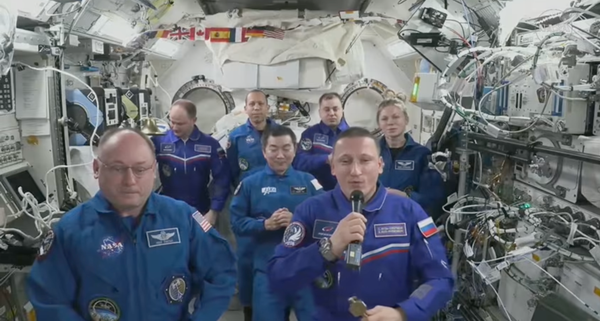
Screenshot via NASA YouTube
Command over the International Space Station (ISS) has changed hands. In a ceremony onboard the station on Monday, NASA astronaut Mike Fincke relinquished the charge of the ISS’s Expedition 74 over to Russian cosmonaut Sergey Kud-Sverchkov.
Fincke thanked his fellow crew members on the ISS as he handed over command to Kud-Sverchkov, adding that it had been great to serve alongside the Russian cosmonaut before thanking each of the other Expedition 74 crew individually.
“It’s bittersweet,” Fincke said during the live-streamed ceremony, which was broadcast from the ISS. Fincke then handed a key to the ISS to Kud-Sverchkov.
On supporting science journalism
If you’re enjoying this article, consider supporting our award-winning journalism by subscribing. By purchasing a subscription you are helping to ensure the future of impactful stories about the discoveries and ideas shaping our world today.
“Despite all the changes and all the difficulties, we are going to do our job onboard ISS, performing all the scientific tasks, maintenance tasks here, whatever happens,” Kud-Sverchkov said before making his first command: a group hug.
The exchange came after NASA ordered the evacuation of four astronauts who are currently on the ISS because one of them fell sick; NASA has described the unidentified crew member as “stable” but hasn’t released any further details about their identity or condition. The departing quartet make up Crew-11: Fincke, fellow NASA astronaut Zena Cardman, Japan’s Kimiya Yui and cosmonaut Oleg Platonov.
Despite the fact that one of them prompted such an unprecedented move, all seven members of Expedition 74 appeared and spoke during the broadcast on Monday.
Their departure will reduce the station’s occupants to just three—NASA’s Chris Williams and cosmonauts Kud-Sverchkov and Sergei Mikaev, who together make up the Soyuz MS-28 crew.
The departing astronauts are expected to undock from the station on Wednesday before they splash down off the coast of California sometime in the early hours on Thursday morning local time.
NASA hasn’t released any details about what exactly happened onboard the station to prompt the evacuation, but the situation is a first: the agency has never brought a crew home from the ISS ahead of schedule because of a medical problem before. Officials haven’t revealed which crew member has been affected or what issue they have encountered.
Monday’s command handover was also atypical: Fincke’s early departure means the station command falls to the next highest-ranking crew member onboard, who is Kud-Sverchkov. Before the evacuation was ordered, Fincke had expected to transfer leadership of the station to the incoming Crew-12 commander, Jessica Meir—who, along with the three other members of Crew-12, is slated to arrive at the ISS in February.
It’s Time to Stand Up for Science
If you enjoyed this article, I’d like to ask for your support. Scientific American has served as an advocate for science and industry for 180 years, and right now may be the most critical moment in that two-century history.
I’ve been a Scientific American subscriber since I was 12 years old, and it helped shape the way I look at the world. SciAm always educates and delights me, and inspires a sense of awe for our vast, beautiful universe. I hope it does that for you, too.
If you subscribe to Scientific American, you help ensure that our coverage is centered on meaningful research and discovery; that we have the resources to report on the decisions that threaten labs across the U.S.; and that we support both budding and working scientists at a time when the value of science itself too often goes unrecognized.
In return, you get essential news, captivating podcasts, brilliant infographics, can’t-miss newsletters, must-watch videos, challenging games, and the science world’s best writing and reporting. You can even gift someone a subscription.
There has never been a more important time for us to stand up and show why science matters. I hope you’ll support us in that mission.