


A dangerous experiment is playing out on a cruise ship with hantavirus
The tragic and fatal outbreak of hantavirus onboard a luxury cruise ship highlights the gaps in research and treatments for the rare and mysterious infection—including how the virus spreads among people
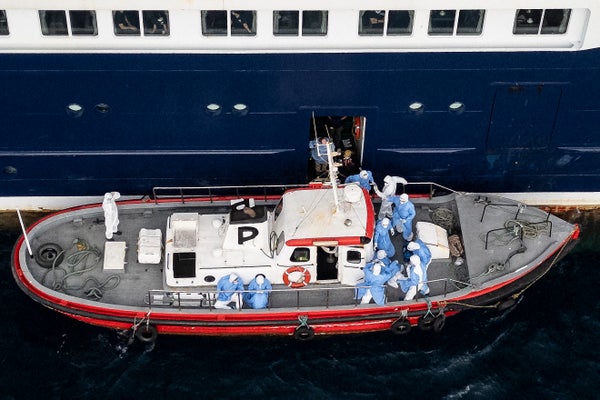
Photo by AFP via Getty Images
The fatal outbreak of hantavirus on a cruise ship is a tragic case study in how pathogens in this mysterious family of viruses spread among people. Little is known about the mechanisms of human-to-human transmission, experts say, largely because of how rare such outbreaks are.
“This is kind of a unique opportunity to try to understand what the virus is doing,” says Alison Kell, a virologist at the University of New Mexico. The World Health Organization says it suspects human-to-human transmission is driving the outbreak, which has seen at least eight people onboard the MV Hondius become sickened or die with a suspected or confirmed case of hantavirus. Several of these individuals have been identified as infected with the Andes virus, which is the only type of hantavirus known to be capable of human-to-human transmission.
Hantavirus typically spreads when humans come into contact with infected rodents and their urine or feces. The outbreak currently plaguing the Hondius is only the second confirmed outbreak where hantavirus was transmitted from person to person. In 2018, 34 people were infected and 11 died in an outbreak that started at a party in Argentina. Prior to that, there had been reports of human-to-human spread, but researchers couldn’t rule out that they had both been exposed to rodents, Kell says.
On supporting science journalism
If you’re enjoying this article, consider supporting our award-winning journalism by subscribing. By purchasing a subscription you are helping to ensure the future of impactful stories about the discoveries and ideas shaping our world today.
Three people have died as a result of the infection, which can cause fluid buildup in the lungs and hemorrhagic fever, among other symptoms. Another three, including the ship’s doctor, have been medically evacuated to receive treatment in the Netherlands. And a passenger who was on the ship and disembarked on Saint Helena has also tested positive for the virus and is receiving treatment at the University Hospital Zurich in Switzerland.
Access to the ship is limited, and the ship is experiencing trouble docking anywhere. Passengers who are still onboard have been taking isolation precautions to try to prevent further spread, but Kell says researchers will want to gather samples of the virus from the ship in order to sequence them. That would allow the scientists to determine if “this strain of Andes virus might be different from other hantaviruses or other strains of Andes hantavirus that don’t appear to cause human human transmission,” she says.
Any additional knowledge would be a boon for understanding a virus that’s largely a mystery, at least in part because of its rarity. While the mortality rate from hantavirus can be as high as 50 percent, fewer than 900 cases were recorded in the U.S. between 1993 and 2023, according to the U.S. Centers for Disease Control and Prevention.
While there’s reason to believe this particular strain of the Andes hantavirus can spread through exposure to saliva, it’s unclear if that extends to airborne saliva droplets, such as those spread through a cough or a sneeze. Virologists have long assumed “that the virus just is not very efficiently transmitted human to human, because the small outbreaks that have occurred in the past have always involved either family members or health care workers who have prolonged, very close contact with infected patients,” says Scott Weaver, a professor of microbiology and immunology and pathology and director of a Global Virus Network Center of Excellence at the University of Texas Medical Branch.
There’s not much direct evidence of airborne spread, Weaver says, but the limited data and difficulty of studying an ongoing outbreak such as this one means it can’t be fully ruled out. Public health officials are already responding to that uncertainty. South African health minister Aaron Motsoaledi said in a press release that 62 other people who may have been exposed to the virus have been identified, including medical workers in several cities where affected passengers received care.
“The total number of people who were traced and who could have come in contact with them were 62. [Some] 42 of them have already been traced, and they are being observed. The work is ongoing,” Motsoaledi said.
The ship’s other passengers remain in limbo and have been unable to leave. Plans are being worked out for the Hondius to sail to the Canary Islands to berth, but the exact point of arrival and any quarantine regimen for the passengers isn’t yet clear.
The precautions are necessary, says Colleen Jonsson, a virologist at the University of Tennessee Health Science Center, because of the possibility of the virus mutating to become more virulent. As witnessed during the COVID pandemic, viruses can mutate as they pass from person to person, and those changes to their genetic structure can make them more dangerous. Indeed, the high mortality rate of hantavirus has led some public health researchers to raise the pathogen as a candidate to watch because, if it was able to spread more easily, it could spark a particularly horrific pandemic.
Still, Kell says she doesn’t think the passengers on the cruise ship are likely to cause a global incident. Although biology can always surprise, “because there are so limited cases, there are more limited opportunities for mutation and subsequent spread,” she says. “I’m not going to discount the possibility that that could happen. I would mark it, from my personal opinion, as relatively low risk but something to watch for sure.”
It’s Time to Stand Up for Science
If you enjoyed this article, I’d like to ask for your support. Scientific American has served as an advocate for science and industry for 180 years, and right now may be the most critical moment in that two-century history.
I’ve been a Scientific American subscriber since I was 12 years old, and it helped shape the way I look at the world. SciAm always educates and delights me, and inspires a sense of awe for our vast, beautiful universe. I hope it does that for you, too.
If you subscribe to Scientific American, you help ensure that our coverage is centered on meaningful research and discovery; that we have the resources to report on the decisions that threaten labs across the U.S.; and that we support both budding and working scientists at a time when the value of science itself too often goes unrecognized.
In return, you get essential news, captivating podcasts, brilliant infographics, can’t-miss newsletters, must-watch videos, challenging games, and the science world’s best writing and reporting. You can even gift someone a subscription.
There has never been a more important time for us to stand up and show why science matters. I hope you’ll support us in that mission.