
Resident Evil Requiem has a complicated story, though that shouldn’t come as a surprise to anyone who has kept up with the series over 30 years. Capcom’s survival horror games are filled with evil organizations and similarly-named viruses that can be tough to keep straight. At first, Requiem seems to be getting away from all that with its new character, Grace Ashcroft, but it soon becomes clear that’s not the case. In fact, Requiem might be the most lore-intensive game in Resident Evil’s history, thanks to how many loose threads it attempts to tie up in its ending.
Even if you’ve played every game in the series, the finale might still leave you scratching your head with its mess of proper nouns. To help you unpack it all, here’s a breakdown of exactly what happens at the end of Resident Evil Requiem and how it ties into the series’ past.
This article contains spoilers for Resident Evil Requiem.
A little setup is required, because there are a few mysteries swirling around Requiem ahead of its ending. The first is that Leon S. Kennedy is investigating what’s been dubbed Raccoon City Syndrome. Those who survived the bombing of Raccoon City back in 1998’s Resident Evil 3: Nemesis are suffering long-term side effects. They have developed black rashes on their skin and are slowly dying from the infection. Leon has a case of it himself, so he’s particularly invested in figuring out what has happened.
Meanwhile, Grace Ashcroft is kidnapped by Dr. Victor Gideon. It’s unclear why for most of the game; all Grace knows is that it has to do with something called “Elpis.” Through lore documents collected throughout the game, Grace begins to piece together what exactly Elpis is. At first glance, it seems like another T-virus variant that’s going to turn the world into zombies. Classic. But the deeper the story goes, the more that’s called into question.
There’s also Zeno, a secondary villain who sure looks a lot like the very dead Albert Wesker. All we really know about him is that he wants to use Elpis for evil. We also learn that he’s part of The Connections, a shadowy group mentioned in Resident Evil Village.
All of this reaches a climax when Leon and Grace enter ARK, an Umbrella Corporation research facility underneath Raccoon City. There, Grace finds some long-hidden secrets involving the origins of the company, how its work was covered up by the United States government, and what actually happened to its enigmatic co-founder, Ozwell E. Spencer. It all culminates in a tense moment where Leon and Grace find the room containing Elpis samples. Leon is too weak to resist when Zeno arrives to stop the two from destroying Elpis. Grace is given a final choice as she stands in front of the machine containing Elpis: save or destroy it. Two endings sprout from that choice.

The very bad ending
If you choose to destroy Elpis, you’re treated to an extremely bleak ending. ARK begins to crumble as Zeno freaks out. Grace is able to get away from him, but Leon is too weak to fight him off. As the platform Leon and Zeno are standing on collapses into the abyss, Leon looks up at Grace and says “At least I could save you.” It’s a culmination of his character arc throughout Requiem. Leon’s entire story revolves around his survivor’s guilt from the destruction of Raccoon City. He was, after all, a rookie cop when it happened. He escaped town with Claire Redfield, but left tens of thousands to die when the United States government bombed the city to contain the zombie outbreak happening within it. He gets to redeem himself by saving Grace.
That victory is short-lived. Zeno shoots Leon in the head at point-blank and kills him. Grace watches in horror as both Leon’s body and the still-living Zeno fall into darkness. She survives and Elpis is gone, but at what cost? The story ends there, with no final boss fight.
The true ending
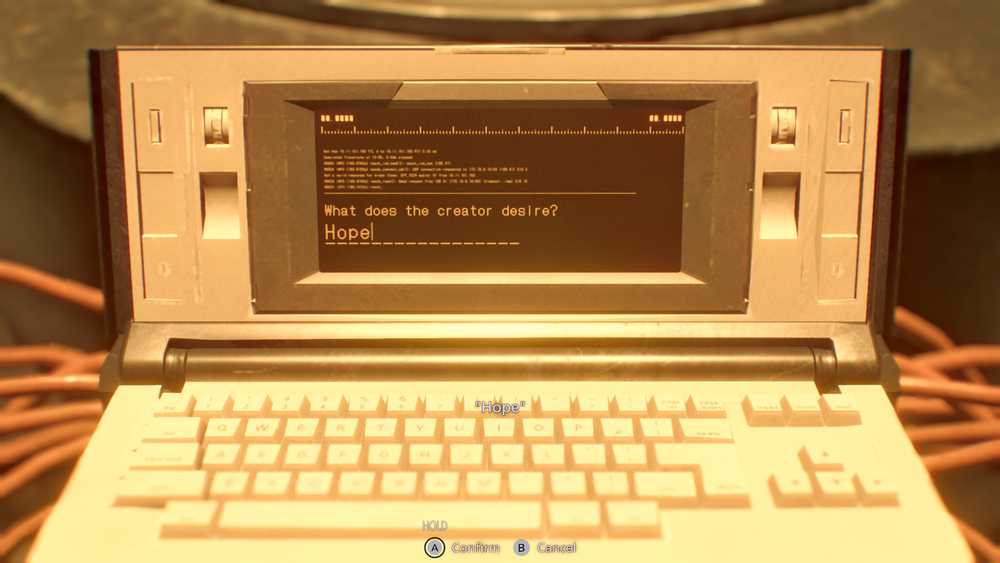
That’s the miserable version. The canon ending happens if Grace chooses not to destroy Elpis. It sounds counterintuitive, but Elpis is actually an antidote, not a virus. In the build-up to the encounter, we get a pretty major revelation about Ozwell E. Spencer. It turns out he felt immense guilt over all those mutagenic viruses he created. At the end of his life, he created Elpis as a final act of repentance. It won’t bring back the dead, but it can at least destroy all zombie bioweapons and cure the Raccoon City survivors.
So that’s what Grace does. She injects Leon with Elpis and quickly reverses his condition. All is well until Gideon enters the scene. His assumptions about Elpis being a superweapon were wrong, yes, but he still has a vision. With Elpis having the potential to wipe out all virus-based weapons, he believes that will throw a world order built around warfare into chaos. That doesn’t really make a lot of sense, as Zeno angrily points out. Gideon responds by killing him, calling him a “cheap imitation” (implying that he does indeed look like Wesker on purpose), and then turning into a giant monster. A big boss fight ensues, with Leon back at full health. Our heroes kill him, but are left trapped inside of ARK. They accept their impending death as the lights go out.
And then, a deus ex machina! The BSAA, an anti-bioweapon group that has appeared in recent games, swoops down to save them. A soldier passes Leon a message from “Captain Redfield,” as in Chris Redfield. We don’t hear what that message is, but we soon flash forward to find Leon and Grace safe and sound. A news report ties up some loose ends: Umbrella’s secrets are exposed and the Justice Department opens an investigation into the US government cover-up surrounding it. (It’s suggested that the government deliberately drove Umbrella into bankruptcy to cover its involvement.)
One final post-credits scene shows us two things. One is that Grace continues working with the FBI after the story wraps up. The other is a bit of sequel bait. Back at ARK, the BSAA soldiers are dead. They’ve been killed by another group of soldiers from a mystery organization, who retrieve something off-screen. The game ends, setting up a sequel about whatever happened there.

The bonus lore
If you’re still confused about it all, don’t worry: Your reward for beating the game is a 60-page lore document that fills in every single gap. This contains some crucial information. For starters, it reveals that Spencer began his research amid the Cold War, fearing a return to the “horrors of the Second World War.” His fear that humanity would repeat its worst crimes led him to seek an evolution of the human race. That vision got mutated by his co-founder, James Marcus, who instead used that idea to turn people into living bioweapons. Internal politics ensued. Marcus was pushed out, and Spencer started developing Elpis inside of ARK.
What was the deal with Marcus? It turns out he had ties to The Connections, the group Zeno was part of. We get way more detail about what that organization is here, but it’s still left very mysterious. They were involved in criminal activity in the 1980s and have since been pulling a lot of strings behind the scenes. In fact, they were responsible for the 1998 Raccoon City bombing in some way. They’re the ones that lobbied the US government to launch a missile at the city — not to stop the infection, but to stop Spencer, destroy Umbrella, and seize their assets. That plan worked, and The Connections gained control of ARK and Elpis, assuming it was a new weapon.
The rabbit hole goes deeper. We learn that Tricell, the villainous military group that Wesker was working for in Resident Evil 5, was also tied to The Connections. And we also learn that President Benford was killed in Resident Evil 6 because he was going to expose all this.
As for Grace? It turns out she was Spencer’s adoptive daughter. He took her in as another way to make amends for his crimes. After his death, Spencer left Grace in the care of Alyssa Ashcroft, the journalist who conducted his final interviews.
There are some finer details, but that’s the gist of it. Spencer was out for redemption, and The Connections were the real big bads. Umbrella Corporation was always just a cog in a much bigger machine. There are a lot of retcons packed in there, so don’t get too hung up on plot holes. This is where the series stands as is, and we’ll certainly see more of it, judging by Requiem’s post-credits scene.