

(RNS) — When two teenage shooters armed with multiple weapons began firing on the Islamic Center of San Diego last month, a licensed security guard hired by the mosque exchanged fire with the shooters and warned others to flee. That guard — Amin Abdullah — lost his life in the attack, as did two other Muslims on the property.
Abdullah’s presence likely prevented a far deadlier attack, but it also raised long-standing concerns about whether Muslim institutions have adequate security, training and planning to foil such targeted attacks and, critically, whether the federal government is invested in helping them.
Next week, the U.S. Department of Homeland Security is expected to announce awards of $274.5 million in nonprofit security grants to houses of worship and other religious institutions. Known as the Nonprofit Security Grant Program, the program is administered by the Federal Emergency Management Agency under the DHS.
The grant program has become an anchor for many religious nonprofits as they try to harden high-risk facilities from physical and cybersecurity attacks with cameras, fencing, gates, bollards, reinforced doors and windows and ballistic film.
But some Muslim organizations are already warning they don’t expect any of their institutions to receive federal security grants in this latest round of funding.
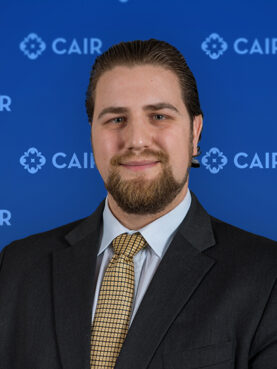
Robert McCaw (Photo courtesy of the Council on American-Islamic Relations)
“We’re not aware of any Muslim organization receiving grants, and if they did, it would be tantamount to the tokenization to say that Muslims had received the grants,” said Robert McCaw, government affairs director for the Council on American-Islamic Relations. “The entire program lacks transparency, and it’s incredibly hard to determine which communities are benefiting the most from them.”
American Muslim organizations have had a long and uneasy relationship with the popular security grants program, created in 2004 in the wake of the 9/11 attacks and the ensuing war on terror.
But Muslim institutions’ wariness of the program has grown under the Trump administration. Last year, DHS unveiled new terms and conditions for the program that made many Muslim organizations even more concerned about applying for security grants. Those conditions require all NSGP recipients to cooperate with immigration enforcement officials, refrain from operating “any programs that advance or promote DEI” and avoid “discriminatory prohibited boycott,” which could include some forms of advocacy for Palestinian rights.
Under former DHS Secretary Kristi Noem, the agency reportedly paused grants for Department of Government Efficiency, or DOGE, review; discussed proposals for a blanket ban on Muslim organizations receiving grants; and later stripped funding from dozens of Muslim organizations, using vague allegations of extremism, according to CNN reporting.
CNN and Fox News also reported that DHS relied in part on reports circulated by Middle East Forum, a conservative think tank, when reviewing grant applications from Muslim organizations.
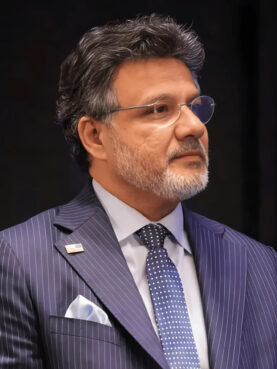
Azhar Azeez (Photo courtesy of the Islamic Society of North America)
That included a review of an application from the Islamic Society of North America that DHS rejected, according to CNN and Azhar Azeez, CEO of the national Muslim group. ISNA had received a grant of $150,000 during the Biden administration to upgrade its Indianapolis headquarters’ security systems and fencing.
“It is very biased to target the American Muslim community and deprive them of these grants,” Azeez said. “Every single faith-based group should benefit from such initiatives. Muslims should not be targeted and left behind. And this is very un-American.”
A FEMA spokesperson denied those allegations.
“Under President Trump, DHS protects all Americans from terrorism, regardless of faith,” the spokesperson said in an email to RNS. “Claims that FEMA blocked funds from Muslim groups are false. All applicants are evaluated equally based on risk.”
Still, Azeez said, in previous administrations DHS representatives held presentations and training at mosques across the country to encourage Muslim groups to apply for security grants. To his knowledge, DHS under Trump has not done such outreach to Muslim organizations, he said.
CAIR also urged DHS officials to host a briefing for American Muslim leaders on how the federal agency will “ensure their equal access to the NSGP.” DHS has not responded, McCaw said.
This is not the first time Muslims have worried about whether they are being given fair access to the NSGP and an equal opportunity to enhance their security.
In the wake of 9/11 and the war on terror, legislation such as the Patriot Act expanded the powers of DHS to investigate and infiltrate American Muslim communities, mosques and charities. That led some Muslim groups to outright oppose the NSGP.
The Muslim Justice League, a Boston-based policy advocacy organization, has long argued Muslims should not apply for NSGP funding.
“There’s growing concern and understanding that these agencies, like the Department of Homeland Security and the FBI, are the same ones who are going after our community,” said Fatema Ahmad, deputy director of the league. “You cannot take money from that same institution and expect that DHS is really invested in our safety, when it’s clearly not.”
In its first years in the mid-2000s, the security grant program primarily benefited Jewish institutions — synagogues, Jewish day schools and nonprofits. Those institutions have received millions in grant dollars to beef up security. Increasingly, more faith groups have received funding. Still, last year, after a rash of antisemitic attacks, Congress allocated an additional $94 million supplemental in DHS’ budget to Jewish institutions.
Jewish community leaders are now asking for more. On Wednesday (June 10), two congressmen introduced the Jewish American Security Act, a companion bill to a Senate measure by the same name that asks for $1 billion annually for the security grant program to benefit all faiths as well as secular nonprofits. (The 2026 fiscal year cycle caps the program at $300 million.)
FEMA does not provide a public list of award recipients and leaves it up to the states to announce grants, but over the years, mosques, Muslim schools and other nonprofits were able to access grants.
The Islamic Center of San Diego, for example, collected a total of $600,000 in federal security grants over the past 10 years. It also won a $590,000 state of California security grant.

Police stage at the scene of a shooting outside the Islamic Center on Monday, May 18, 2026, in San Diego. (AP Photo/Gregory Bull)
Some of the grants were used for installing fencing and upgrading camera systems. The mosque raised the money to pay Abdullah from its own community.
Now, with anti-Muslim sentiment growing across the country, many feel it’s urgent to do more to protect worshippers.
Some pointed out that Muslims are at a financial and structural disadvantage. Many mosques are volunteer-run, said Ghouse Mohammed, head of security for the Islamic Center of San Diego.
Mohammed has helped his mosque apply for federal and state security grants for more than a decade. But he said the application process is difficult and requires skilled grant writers.
“We lack experts,” he said of mosques across the country. “We are not equipped to effectively participate in these competitive grants. And that’s why a very small percentage of Muslim institutions have been recipients.”
Across the country, some Jewish groups have stepped up to help. The Jewish Federation of Greater Pittsburgh, for example, helped the Attawheed Islamic Center in Carnegie, Pennsylvania, apply for a grant through the state security grant program. Last year, the mosque was awarded $100,000 to enhance security at a new community center with cameras, lighting and more durable security doors.
“To be honest, without the help, guidance and coordination provided by the Jewish Federation, it would have been very difficult for us to navigate the grant process,” said Bilal Stambouli, the mosque’s executive director. “We are truly grateful for all the assistance and support they provided along the way.”
Stambouli said one challenge with the NSGP is that it requires a professional vulnerability assessment, which can cost several thousand dollars. The Jewish Federation arranged for an assessment free of charge.
State security grants have been a growing source of funding for many Muslim organizations, in part because they do not include conditions that the Trump administration imposed. At least 10 states now have nonprofit security grant programs.
Private funding is also growing.
Last month, the North American Islamic Trust, a not-for-profit endowment that holds titles to hundreds of mosques, created a new fund to support security efforts at U.S. mosques. The fund will focus on educating mosque leaders about security planning and how to apply for federal, state and private grants, said Hanif Mohebi, a spokesperson for NAIT.
The fund is meant to provide sustainable support for generations of American Muslim institutions. If the endowment grows significantly, Mohebi said, it could eventually provide mosques with direct financial support for security upgrades.
“One of the biggest problems with our community is we don’t think long term as much as we should,” he said. “We need to move away from being reactive to proactive.”
It’s not clear if it will be enough. Mohammed of the Islamic Center of San Diego wants mosques around the country to consider the deadly shooting as a wake-up call.
“There was no such incident in the past where mosques were made this vulnerable in the United States,” he said. It is, he added, “a valid reason for more mosques to be considered for funding.”